Q&A - PSLE Science
-
chrisu:
Hi chrisuHi Tianzhu,
In order for a bulb to light up, there must be a battery source (potential difference though again not in primary syllabus) connected to it correctly. That is the +ve of the battery connected to one point of the bulb and the -ve of the same battery to the other point of the same bulb. Diagram (c) illustrate this point. (sorry for the poor drawing). Technically, there is a battery source (potential difference) connected to the bulb correctly.
Good Morning.
I am thinking about children doing experiment using miniature light bulbs with miniature plastic bulb holders.
The configuration is as shown in the image. I am not too sure if it works, as I don’t have a set of kit to carry out the experiment at home.
http://farm7.static.flickr.com/6121/6025190684_1f4a3c9165_z.jpg
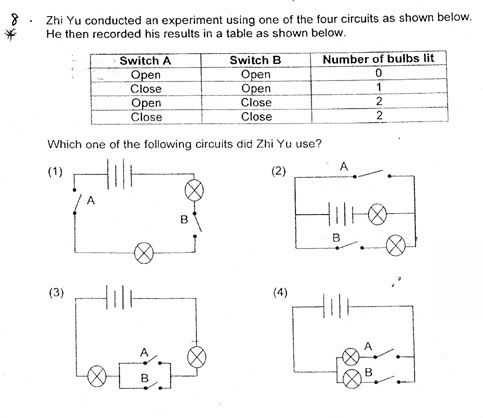
I see the schematic diagram of option (2) as two parallel loops sharing a single source.
Loop A has one bulb A and loop B consists of bulb B as well as bulb A.
The sum of currents entering any junction in a circuit is equal to the sum of currents leaving the same junction. In this case, more current is passing through bulb A, hence it’s brighter than bulb B.
Best wishes -
Good morning Tianzhu.
Thanks for the pictorial diagram. I've redrawn it and it's still the same as yours just that the point of the brown wire is now at the same positive terminal of the battery. The bulb B will not light up is both its wire is connected to the same positive point of battery.
http://img.photobucket.com/albums/v160/guppiesonli/Misc/Bulb2.jpg\">
tianzhu:
Hi chrisuchrisu:
Hi Tianzhu,
In order for a bulb to light up, there must be a battery source (potential difference though again not in primary syllabus) connected to it correctly. That is the +ve of the battery connected to one point of the bulb and the -ve of the same battery to the other point of the same bulb. Diagram (c) illustrate this point. (sorry for the poor drawing). Technically, there is a battery source (potential difference) connected to the bulb correctly.
Good Morning.
I am thinking about children doing experiment using miniature light bulbs with miniature plastic bulb holders.
The configuration is as shown in the image. I am not too sure if it works, as I don’t have a set of kit to carry out the experiment at home.
http://farm7.static.flickr.com/6121/6025190684_1f4a3c9165_z.jpg
I see the schematic diagram of option (2) as two parallel loops sharing a single source.
Loop A has one bulb A and loop B consists of bulb B as well as bulb A.
The sum of currents entering any junction in a circuit is equal to the sum of currents leaving the same junction. In this case, more current is passing through bulb A, hence it’s brighter than bulb B.
Best wishes -
I've purchased these bulbs from Sim Lim just for experiment for my daughter to visualise better.
The first one below shows both bulbs light up equally though picture may not show equal brightness due to camera. This is the same before Switch A is closed (Just Swithc B closed);
Now with both Switch A and B closed, only 1 bulb is lighted up (very bright) and the other buld is not lighted at all;
Hope it's clear. Thanks. -
Hi Chrisu
Thank you for carrying out the experiment. This means none of the possible answers given in the test paper is correct.
http://img.photobucket.com/albums/v160/guppiesonli/Misc/P6-Sc.jpg
I apologise for leading you the wrong way.
You may wish to check with your kid’s teacher for the right answer.
Best wishes -
It's alright Tianzhu. I will get my daughter to check with the teacher.
I understand why most ppl choose (2) as answer; It is true that total current flow to that junction equal to the sum of both flowing out. IT = Ir + IR;
Let us not forget that when Switch A is closed, the wire resistance is probably very low (can assume to be 0.0001ohm). You may read here for http://www.furryelephant.com/content/electricity/resistance-ohms-law/.
So the total resistance of the wire (when switch A closed) and bulb (assume to be 10ohm) in parallel = 0.0000099 ohm.
Total resistance in circuit = 10 + 0.0000099 = 10.0000099 ohm.
Therefore total current IT = 3/10.0000099 = 0.2999997 A
Voltage across the first bulb connected nearest to battery = IT x 10 ohm
= 0.2999997 x 10 = 2.999997V
As you can see, most of the 3V battery is dropped across this bulb (2.999997V) and very very little voltage across the other bulb - thus the voltage is not high enough to light up that bulb.tianzhu:
Hi Chrisu
Thank you for carrying out the experiment. This means none of the possible answers given in the test paper is correct.
http://img.photobucket.com/albums/v160/guppiesonli/Misc/P6-Sc.jpg
I apologise for leading you the wrong way.
You may wish to check with your kid’s teacher for the right answer.
Best wishes -
Hi Chrisu
I didn't pay attention to the question till you posted your illustrations and experiments.
You have very good electrical knowledge. Many will have great difficulty visualising the short-circuit caused by switch A on bulb B - few will know how to flip switch A down like you did in your diagram. I believe the pr sch teacher who set the question didn't realise that too. There are many such mistakes in Pr Sc questions. Yes, you are absolutely correct, none of the circuits fit the results given.
Your child is very lucky to have a parent like you.
Cheers.
ps
Just saw your latest circuit diagram. You are guaranteed electrical engineering trained.
-
Oh dear! I just revised electricity but I am seeing even more stars now! Chrisu, agree your child is really lucky! Appreciate to know (1) where in sim lim to get the experiment kits? (2) please update us when the teacher response regarding the question, thanks very much.
To all : about short circuit - is it not in psle syllabus? I came across one oe question in p5 process skills assessment book and also one paragraph explanation in mc psle science guide. -
Thanks atutor2001. I've studied Electronics in poly many years back (70s) and have forgotten most of it.
I remember I've taught my eldest son in sec.4 last year on bulb brightness in series and parallel circuit (one of those favourite topic in school) and some other bulb questions, and now my daughter P6 also learning the same thing in the worksheet and test.
Primary school text book and what teacher taught are always very brief but the exam and test or worksheet are very difficult.atutor2001:
Hi Chrisu
I didn't pay attention to the question till you posted your illustrations and experiments.
You have very good electrical knowledge. Many will have great difficulty visualising the short-circuit caused by switch A on bulb B - few will know how to flip switch A down like you did in your diagram. I believe the pr sch teacher who set the question didn't realise that too. There are many such mistakes in Pr Sc questions. Yes, you are absolutely correct, none of the circuits fit the results given.
Your child is very lucky to have a parent like you.
Cheers.
ps
Just saw your latest circuit diagram. You are guaranteed electrical engineering trained. -
I bought it from the shop selling electronic components faching the escalator (2nd floor). Sim Lim the one selling electrical appliances and components (not the one selling computer stuff). Near to Sungei Rd that Sim Lim. It's not a kit, just buy some bulbs and wire.
Will update once the teacher get back to us.
Primary school probably won't use the term short circuit but they have to know how to connect a bulb to the battery source correctly.pixiedust:
Oh dear! I just revised electricity but I am seeing even more stars now! Chrisu, agree your child is really lucky! Appreciate to know (1) where in sim lim to get the experiment kits? (2) please update us when the teacher response regarding the question, thanks very much.
To all : about short circuit - is it not in psle syllabus? I came across one oe question in p5 process skills assessment book and also one paragraph explanation in mc psle science guide. -
I remembered short circuit did come out in PSLE. If I am not wrong, Pr students are expected to know that electricity will "flow through the path that has the least resistance i.e. obstacle".
Hello! It looks like you're interested in this conversation, but you don't have an account yet.
Getting fed up of having to scroll through the same posts each visit? When you register for an account, you'll always come back to exactly where you were before, and choose to be notified of new replies (either via email, or push notification). You'll also be able to save bookmarks and upvote posts to show your appreciation to other community members.
With your input, this post could be even better 💗
Register Login