Q&A - PSLE Science
-
My daughter gave the same answer - (2) too.
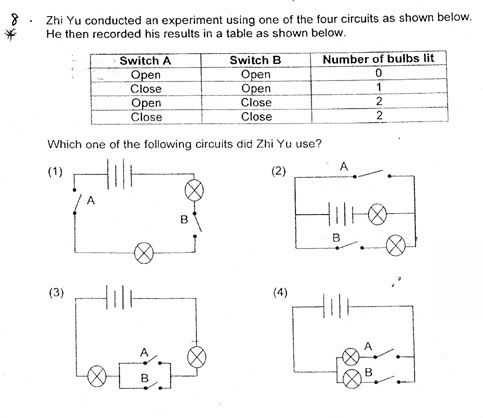
But I think if Both Switches A and B are closed, wouldn't the Switch A caused a short circuit to the bulb besides Switch B? So only 1 bulb will be lighted up.andante:
I thought that the answer is (2).chrisu:
Hi, can help with this question? I don't think any one of the answers is correct. Pls see attached picture. Thank you.

http://img.photobucket.com/albums/v160/guppiesonli/Misc/P6-Sc.jpg\">
-
Please help.
http://www.orlesson.org/orp/ScienceExam.html
Question 13 - Populations of four different organisms A, B, C and D.
Worksheet answer (1). Should the correct answer be (3).
Question 21 - Substance X.
Worksheet answer (3). Should the correct answer be (2).
Question 26 - Length of spring X.
Worksheet answer (2). Should the correct answer be (4).
TIA. -
P5G:
Q13, my answer is (1) because the keyword in the question is \"thrive\"Please help.
http://www.orlesson.org/orp/ScienceExam.html
Question 13 - Populations of four different organisms A, B, C and D.
Worksheet answer (1). Should the correct answer be (3).
Question 21 - Substance X.
Worksheet answer (3). Should the correct answer be (2).
Question 26 - Length of spring X.
Worksheet answer (2). Should the correct answer be (4).
TIA.
Thrive means to grow in number. However, the number of organism C remains the same and does not \"thrive\".
Q21, my answer is (2) because oil can solidify at low temperature. Anyway, it is important to follow the question closely. It is stated in the question \"until substance X change its state\", so as long as the given item is a liquid, I will accept as a possible answer.
Q26, my answer is also (4) -
chrisu:
Hi chrisuMy daughter gave the same answer - (2) too.
But I think if Both Switches A and B are closed, wouldn't the Switch A caused a short circuit to the bulb besides Switch B? So only 1 bulb will be lighted up.
Good Morning.
In arrangement 2 , you have a single battery connected to two parallel circuits.
Visualise as one circuit with one bulb as compared to another circuit with two identical bulbs.
The sum of currents entering any junction in a circuit is equal to the sum of currents leaving the same junction.
Hence two bulbs will be turned on.
Interesting, you’ve brought up short circuit which I think is not in the PSLE science syllabus.
If one of the paths in a circuit is without a light bulb, the path has very little resistance and virtually all the current take this path. Thus, a short circuit occurs.
Please go to page 29 and refer to Q43 of this testpaper.
http://www.wendykoh.com/08/primary6-nanyangca1-science.pdf
A short circuit occurs when switch D is closed. Notice that the circuit consists of a conducting wire without light bulbs.
You may refer to this link to learn more about short circuit.
http://www.furryelephant.com/content/electricity/complete-circuits/short-circuits/
Hope this helps.
Best wishes. -
Hi Tianzhu,
Good morning to you too, you are pretty early. Thank you for your reply and I do agreed that short circuit may not be a good term to use for Primary school since it's not in syllabus.
In order for a bulb to light up, there must be a battery source (potential difference though again not in primary syllabus) connected to it correctly. That is the +ve of the battery connected to one point of the bulb and the -ve of the same battery to the other point of the same bulb. Diagram (c) illustrate this point. (sorry for the poor drawing). Technically, there is a battery source (potential difference) connected to the bulb correctly.
Diagram (b) light bulb will not light up as the two points of the bulb is connected to the same point (-ve) of the battery. Technically there is no potential difference between the two points of the bulb or the bulb is not connected correctly to the battery.
Diagram (a) shows the answer (2) redrawn to illustrate that only 1 bulb will light up if both switches A and B are closed. For easier understanding, I'm renaming the bulb besides the switch B as Bulb B and the other bulb as Bulb A. The arrow shows the same wiring in the following diagram but drawn differently. In the last diagram of (a), it shows clearly why the Bulb B will not light up because the battery source is not connected to it correctly or no potential difference across it.
As for the link to the Question 43 paper, the model answer is Potential energy ---> Electrical energy when all swithes are closed do agreed with my point. When all swithes are closed, the other appliances will not work thus no light, sound and heat energy converted and only electrical energy is converted as the wire is connected between the +ve and -ve of the battery source. There will be current flowing thru it (wire) as it's a complete circuit. Sad to say it didn't explain why the other 3 appliances has no energy conversion (will not work) since short circuit is not in syllabus.
It will be better if the teacher will to set the question in such manner that the switch is closed individually only since it will still explain the various energy conversion for primary school.
Hope it helps.tianzhu:
Hi chrisuchrisu:
My daughter gave the same answer - (2) too.
But I think if Both Switches A and B are closed, wouldn't the Switch A caused a short circuit to the bulb besides Switch B? So only 1 bulb will be lighted up.
Good Morning.
In arrangement 2 , you have a single battery connected to two parallel circuits.
Visualise as one circuit with one bulb as compared to another circuit with two identical bulbs.
The sum of currents entering any junction in a circuit is equal to the sum of currents leaving the same junction.
Hence two bulbs will be turned on.
Interesting, you’ve brought up short circuit which I think is not in the PSLE science syllabus.
If one of the paths in a circuit is without a light bulb, the path has very little resistance and virtually all the current take this path. Thus, a short circuit occurs.
Please go to page 29 and refer to Q43 of this testpaper.
http://www.wendykoh.com/08/primary6-nanyangca1-science.pdf
A short circuit occurs when switch D is closed. Notice that the circuit consists of a conducting wire without light bulbs.
You may refer to this link to learn more about short circuit.
http://www.furryelephant.com/content/electricity/complete-circuits/short-circuits/
Hope this helps.
Best wishes. -
chrisu:
Hi chrisuHi Tianzhu,
In order for a bulb to light up, there must be a battery source (potential difference though again not in primary syllabus) connected to it correctly. That is the +ve of the battery connected to one point of the bulb and the -ve of the same battery to the other point of the same bulb. Diagram (c) illustrate this point. (sorry for the poor drawing). Technically, there is a battery source (potential difference) connected to the bulb correctly.
Good Morning.
I am thinking about children doing experiment using miniature light bulbs with miniature plastic bulb holders.
The configuration is as shown in the image. I am not too sure if it works, as I don’t have a set of kit to carry out the experiment at home.
http://farm7.static.flickr.com/6121/6025190684_1f4a3c9165_z.jpg
I see the schematic diagram of option (2) as two parallel loops sharing a single source.
Loop A has one bulb A and loop B consists of bulb B as well as bulb A.
The sum of currents entering any junction in a circuit is equal to the sum of currents leaving the same junction. In this case, more current is passing through bulb A, hence it’s brighter than bulb B.
Best wishes -
Good morning Tianzhu.
Thanks for the pictorial diagram. I've redrawn it and it's still the same as yours just that the point of the brown wire is now at the same positive terminal of the battery. The bulb B will not light up is both its wire is connected to the same positive point of battery.
tianzhu:
Hi chrisuchrisu:
Hi Tianzhu,
In order for a bulb to light up, there must be a battery source (potential difference though again not in primary syllabus) connected to it correctly. That is the +ve of the battery connected to one point of the bulb and the -ve of the same battery to the other point of the same bulb. Diagram (c) illustrate this point. (sorry for the poor drawing). Technically, there is a battery source (potential difference) connected to the bulb correctly.
Good Morning.
I am thinking about children doing experiment using miniature light bulbs with miniature plastic bulb holders.
The configuration is as shown in the image. I am not too sure if it works, as I don’t have a set of kit to carry out the experiment at home.
http://farm7.static.flickr.com/6121/6025190684_1f4a3c9165_z.jpg
I see the schematic diagram of option (2) as two parallel loops sharing a single source.
Loop A has one bulb A and loop B consists of bulb B as well as bulb A.
The sum of currents entering any junction in a circuit is equal to the sum of currents leaving the same junction. In this case, more current is passing through bulb A, hence it’s brighter than bulb B.
Best wishes -
I've purchased these bulbs from Sim Lim just for experiment for my daughter to visualise better.
The first one below shows both bulbs light up equally though picture may not show equal brightness due to camera. This is the same before Switch A is closed (Just Swithc B closed);
Now with both Switch A and B closed, only 1 bulb is lighted up (very bright) and the other buld is not lighted at all;
Hope it's clear. Thanks. -
Hi Chrisu
Thank you for carrying out the experiment. This means none of the possible answers given in the test paper is correct.
http://img.photobucket.com/albums/v160/guppiesonli/Misc/P6-Sc.jpg
I apologise for leading you the wrong way.
You may wish to check with your kid’s teacher for the right answer.
Best wishes -
It's alright Tianzhu. I will get my daughter to check with the teacher.
I understand why most ppl choose (2) as answer; It is true that total current flow to that junction equal to the sum of both flowing out. IT = Ir + IR;
Let us not forget that when Switch A is closed, the wire resistance is probably very low (can assume to be 0.0001ohm). You may read here for http://www.furryelephant.com/content/electricity/resistance-ohms-law/.
So the total resistance of the wire (when switch A closed) and bulb (assume to be 10ohm) in parallel = 0.0000099 ohm.
Total resistance in circuit = 10 + 0.0000099 = 10.0000099 ohm.
Therefore total current IT = 3/10.0000099 = 0.2999997 A
Voltage across the first bulb connected nearest to battery = IT x 10 ohm
= 0.2999997 x 10 = 2.999997V
As you can see, most of the 3V battery is dropped across this bulb (2.999997V) and very very little voltage across the other bulb - thus the voltage is not high enough to light up that bulb.tianzhu:
Hi Chrisu
Thank you for carrying out the experiment. This means none of the possible answers given in the test paper is correct.
http://img.photobucket.com/albums/v160/guppiesonli/Misc/P6-Sc.jpg
I apologise for leading you the wrong way.
You may wish to check with your kid’s teacher for the right answer.
Best wishes
Hello! It looks like you're interested in this conversation, but you don't have an account yet.
Getting fed up of having to scroll through the same posts each visit? When you register for an account, you'll always come back to exactly where you were before, and choose to be notified of new replies (either via email, or push notification). You'll also be able to save bookmarks and upvote posts to show your appreciation to other community members.
With your input, this post could be even better 💗
Register Login