Q&A - PSLE Science
-
P5G:
Hi
Q30 - Energy
Worksheet answer is (2). Should the correct answer be (3)?
I have the answer as you --- (3).
Best wishes -
P5G:
Hi
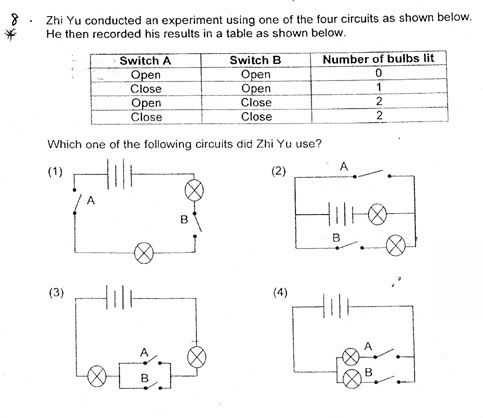
Question 21 - Electricity
Worksheet answer is (1). Should the correct answer be (2)?
For Q21, the answer is (2).
First, watch this video
http://www.youtube.com/watch?v=jxMV0wagR8o&feature=related
If S2 is closed, the wire act as a bypass for the current flowing through the bell, thus it’s easier for the current to flow through wire connecting S2 than the bell. The bell will not ring.
This gives rise to a situation called “short circuit”. A short circuit occurs when the current bypass the light bulb or bell and pass through another path with little resistance.
I can’t find anything on short circuit in my old MC PSLE science guide. If you are interested to find out more, you may find a short write up in this book Physics Matter, Chapter 17.
Some interesting sites which may give you more information.
http://www.energyquest.ca.gov/projects/open-short-circuit.html
http://www.furryelephant.com/content/electricity/complete-circuits/short-circuits/
Hope this helps.
Best wishes -
P5G:
Hi
Q14 - Water pollution
Since the study is on water pollution, one may infer that the difference between the number of fish in the beginning and the number of fish alive in the end shows the pollution level of the water. In this question, the greater the difference, the more polluted the water in the river.
(1) ---- We cannot say the water in the upstream is not polluted as the difference in number of fish between the start and end is 10.
(2) ---- cage W ---- 10(difference) and cage Z ---- 9(difference)
cage X ---- 8 and cage Y ---- 5
So we cannot conclude that downstream is as polluted as upstream.
(3) ---- The study does not suggest that water downstream is more polluted than water upstream. In fact, the water at downstream is less polluted as shown by the study.
How about (2)?
Cage x ---- 8 and cage Y ---- 5
Their differences are less than those at W and Z.This suggests that water at deeper parts is less polluted.
I’m inclined to go for (2).
Best wishes -
andante:
Hi parents,
I thought that the answer is (2).chrisu:
Hi, can help with this question? I don't think any one of the answers is correct. Pls see attached picture. Thank you.

http://img.photobucket.com/albums/v160/guppiesonli/Misc/P6-Sc.jpg\">
Kids are not taught 'short circuit' will choose (2) as answers. Basically, i think the setter just want to test the simple concept learnt in syllabus 'currents flow thr closed circuits but not open circuits.'.
I think even O level students are taught to calculate the resistance, current & voltage for series & parallel circuits but not touch on if the bulbs can 'practically' light up or not.
Of course when parents get involved to tell kids that (2) is impossible due to short circuit, effective resistance, voltage etc (lots of higher level terms), then the qn will become a very complicated one!! Is it the fault of setters to have such a simple yet complicated qn? Is it necessary for parents to tell kids of more adv stuff in this level?
-
bestwishes:
I agree that the setter's intention is probably just to test the simple concept of 'currents flow in a close circuits but not open circuits.'
Hi parents,
Kids are not taught 'short circuit' will choose (2) as answers. Basically, i think the setter just want to test the simple concept learnt in syllabus 'currents flow thr closed circuits but not open circuits.'.....
.....Is it necessary for parents to tell kids of more adv stuff in this level?
However, I also believe that the setter has unknowingly created the short circuit. This is the same kind of error as that of a past PSLE math question which caused an uproar. In that PSLE math question, the setter created a right angle triangle with the lengths that does not conform to Pythagora's theorem (not in Pr syllabus). Many may dismissed that it is ok as the pr students do not know Pythagoras Theorem. But you will be surprised that during the exam itself, many of the smarter kids wasted lots of time verifying their answers because they were using Pythagoras Theorem to check their answer. At the end, everybody was awarded full mark for that question and again lots of dissatisfaction.
Therefore, I am of the opinion that all questions must not go against fundamental principles and concepts regardless whether the kids are aware of such concepts or not. There will always be some smart kids out there who can spot the discrepancy and end up feeling frustrated when they can't find any suitable answers thus affecting their performance for the rest of the paper. -
means that there is current flows thr the bulb but not strong enough to light up the bulb? so if there is a higher voltage, the bulb can light up??
chrisu:
It's alright Tianzhu. I will get my daughter to check with the teacher.
I understand why most ppl choose (2) as answer; It is true that total current flow to that junction equal to the sum of both flowing out. IT = Ir + IR;
Let us not forget that when Switch A is closed, the wire resistance is probably very low (can assume to be 0.0001ohm). You may read here for http://www.furryelephant.com/content/electricity/resistance-ohms-law/.
So the total resistance of the wire (when switch A closed) and bulb (assume to be 10ohm) in parallel = 0.0000099 ohm.
Total resistance in circuit = 10 + 0.0000099 = 10.0000099 ohm.
Therefore total current IT = 3/10.0000099 = 0.2999997 A
Voltage across the first bulb connected nearest to battery = IT x 10 ohm
= 0.2999997 x 10 = 2.999997V
As you can see, most of the 3V battery is dropped across this bulb (2.999997V) and very very little voltage across the other bulb - thus the voltage is not high enough to light up that bulb.tianzhu:
Hi Chrisu
Thank you for carrying out the experiment. This means none of the possible answers given in the test paper is correct.
http://img.photobucket.com/albums/v160/guppiesonli/Misc/P6-Sc.jpg
I apologise for leading you the wrong way.
You may wish to check with your kid’s teacher for the right answer.
Best wishes -
Hi,
Yes there is a current flowing thru the bulb but the potential difference (voltage) across this bulb is too low to light it up. Most electronic components like bulb, bell, etc, need certain voltage to work effectively and that's why when your battery is \"drained out\", your torch light may not work.
For Primary level, I've shown in my earlier drawing that a bulb or component need to connect correctly to the 2 points of the battery for it to work. Some redrawing of the given question circuit is required to show whether it is properly connected to the battery. No knowledge of short cct or calculation or Kirch. law is required.
For Sec. level, they should be taught what is short cct. and calculation of the cct current, voltage, etc. by sec.4.
I've gone thru that in my earlier posts n sorry for the confusion. The calculation are meant for the parents of course, n not the pri. students - so no worry.
Many students n adults still insist that (2) is the correct answer but it is wrong. Sometimes the question is taken from those assessment book which may have wrong answer given and also some sch teacher are not familiar with electronic circuit (it is a true fact some science teachers avoid going to science lab for such topic) know how as they are not trained in this subject.
So no worry for primary level, just redraw to see if the components are connected correctly; very similar to models in maths when we parents first learn it.
Cheers.bestwishes:
[/quote]means that there is current flows thr the bulb but not strong enough to light up the bulb? so if there is a higher voltage, the bulb can light up??
chrisu:
It's alright Tianzhu. I will get my daughter to check with the teacher.
I understand why most ppl choose (2) as answer; It is true that total current flow to that junction equal to the sum of both flowing out. IT = Ir + IR;
Let us not forget that when Switch A is closed, the wire resistance is probably very low (can assume to be 0.0001ohm). You may read here for http://www.furryelephant.com/content/electricity/resistance-ohms-law/.
So the total resistance of the wire (when switch A closed) and bulb (assume to be 10ohm) in parallel = 0.0000099 ohm.
Total resistance in circuit = 10 + 0.0000099 = 10.0000099 ohm.
Therefore total current IT = 3/10.0000099 = 0.2999997 A
Voltage across the first bulb connected nearest to battery = IT x 10 ohm
= 0.2999997 x 10 = 2.999997V
As you can see, most of the 3V battery is dropped across this bulb (2.999997V) and very very little voltage across the other bulb - thus the voltage is not high enough to light up that bulb.
[quote=\"tianzhu\"]Hi Chrisu
Thank you for carrying out the experiment. This means none of the possible answers given in the test paper is correct.
http://img.photobucket.com/albums/v160/guppiesonli/Misc/P6-Sc.jpg
I apologise for leading you the wrong way.
You may wish to check with your kid’s teacher for the right answer.
Best wishes -
I've seen question like brightness of bulb in series n parallel cct in my son physic last year when he was sec.4. Now I'm seeing similar question in my P6 daughter science worksheet recently. It's not taught by teacher nor in text book. You can see that such worksheet are simply compilation of questions from all other unknown sources where errors may occur.
So parents should check if possible what your kids learned are correct.bestwishes:
Hi parents,
I thought that the answer is (2).andante:
[quote=\"chrisu\"]Hi, can help with this question? I don't think any one of the answers is correct. Pls see attached picture. Thank you.
Kids are not taught 'short circuit' will choose (2) as answers. Basically, i think the setter just want to test the simple concept learnt in syllabus 'currents flow thr closed circuits but not open circuits.'.
I think even O level students are taught to calculate the resistance, current & voltage for series & parallel circuits but not touch on if the bulbs can 'practically' light up or not.
Of course when parents get involved to tell kids that (2) is impossible due to short circuit, effective resistance, voltage etc (lots of higher level terms), then the qn will become a very complicated one!! Is it the fault of setters to have such a simple yet complicated qn? Is it necessary for parents to tell kids of more adv stuff in this level?
D:[/quote] -
bestwishes:
Hi bestwishesmeans that there is current flows thr the bulb but not strong enough to light up the bulb? so if there is a higher voltage, the bulb can light up??
Lets just discuss for the sake of better understanding (not for Pr students consumption).
Lets simplify the circuit : a bulb and a wire connected in parallel (short-circuit) to a variable electrical source. Lets assume that the resistance of the wire is 0.001 ohm as provided by chrisu.
For the bulb to light up, the normal voltage across the bulb needs to be 3V.
If we manage to have a electrical source that can maintain a 3V potential across the \"short-circuit\" wire, the current flowing through the short-circuit wire will be I = V/R = 3/0.001 = 3000 amp. This is a very high current and the wire will melt before the bulb can light up, which is why we cannot demonstrate a bulb being lighted up despite being short-circuited by increasing the power supply. -
Not forgetting a battery will have internal resistance and this will vary between a new and used battery. A used battery will have higher internal resistance if I didn't remember wrongly.
Thus the current may not be too high if the battery is shorted.atutor2001:
Hi bestwishesbestwishes:
means that there is current flows thr the bulb but not strong enough to light up the bulb? so if there is a higher voltage, the bulb can light up??
Lets just discuss for the sake of better understanding (not for Pr students consumption).
Lets simplify the circuit : a bulb and a wire connected in parallel (short-circuit) to a variable electrical source. Lets assume that the resistance of the wire is 0.001 ohm as provided by chrisu.
For the bulb to light up, the normal voltage across the bulb needs to be 3V.
If we manage to have a electrical source that can maintain a 3V potential across the \"short-circuit\" wire, the current flowing through the short-circuit wire will be I = V/R = 3/0.001 = 3000 amp. This is a very high current and the wire will melt before the bulb can light up, which is why we cannot demonstrate a bulb being lighted up despite being short-circuited by increasing the power supply.

Hello! It looks like you're interested in this conversation, but you don't have an account yet.
Getting fed up of having to scroll through the same posts each visit? When you register for an account, you'll always come back to exactly where you were before, and choose to be notified of new replies (either via email, or push notification). You'll also be able to save bookmarks and upvote posts to show your appreciation to other community members.
With your input, this post could be even better 💗
Register Login